
'China's growing nexus with Pakistan and the two countries' unresolved territorial disputes with India continue to pose a formidable national security threat to India,' says Brigadier Gurmeet Kanwal (retd).

'Pakistan may feel emboldened to give an upswing to the proxy war in J&K, having secured a better international consensus on its strategic importance.' 'The raising of Pakistani flags by separatists in J&K is an attempt to win psychological space and more of this can be expected as we go into the summer.' 'Pakistan should remain warned that pushing India on this issue will be dangerous.'
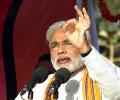
The kind of people Narendra Modi has chosen, the decisions he has taken and the rail and central budgets suggests that he is treading carefully in New Delhi. There is less of innovation and more of continuity, so far. He is not ready to rock the boat and start from scratch, says Sheela Bhatt.
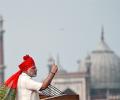
'Independence Day has been India's annual general meeting. For the most part, it has been a forgettable experience of ritual observances. Not so this year... Mr Modi instead presented what I call a moral balance sheet of India,' says Shreekant Sambrani.

Silicon Valley can be replicated, but this will only be achieved so long as fresh talent is welcomed by both our countries - a move that will surely spark a billion ideas and discoveries.

Once again an Indian prime minister has realised that with Pakistan and China, things will not move as he wishes.

'How can Kashmir be demilitarised if the terrorist threat remains and Pakistan continues to incite elements in Kashmir to keep the internal situation unstable?' asks former foreign secretary Kanwal Sibal.

'Pakistan's military leaders have to accept that the policy of proxy wars has damaged Pakistan more than it has damaged the enemy,' says former R&AW chief Vikram Sood.

'The Opposition has no option but to make it an 'All versus One' fight to even think about winning.'

Germany, as the locomotive of Europe, has much to teach India in manufacturing and process management, says Rajeev Srinivasan.

'Tibet remains a prickly issue between the giant Asian nations. China still claims more than 80,000 sq kilometres of Indian territory in the Northeast. Why? Just because Beijing refuses to acknowledge the McMahon line which separates India and Tibet, and this, simply because the 1914 Agreement delineating the border was signed by the then government of independent Tibet with India's then foreign secretary (Sir Henry McMahon),' says Claude Arpi.

'The Modi government's pusillanimity vis-a-vis Pakistan makes almost certain that India will, in the coming weeks and months, be confronted with cross border terrorist actions of increasing intensity,' warns Satish Chandra, former deputy national security adviser.

'Those who have seen the functioning of the Modi government in Gujarat know that the issues related to Hindutva and issues of economy and growth function simultaneously.' 'Modi's politics are based on the understanding of the middle-class consumer society which is in pursuit of material aspirations.' Sheela Bhatt/Rediff.com reveals the Modi government's economic and political plans for the year ahead.
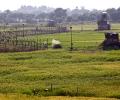
'The incidents have remained confined to the paramilitary forces on both sides with both the armies scrupulously avoiding getting involved. While this incident has been going on, the LOC has been reasonably quiet. Cross border firing achieves no tactical or strategic aims and is more a symptom of hostility. Unfortunately, India has to learn to live with this. Like Israel, we must construct shelters for the border populations and be ready to retaliate in kind,' says Colonel Anil A Athale (retd).
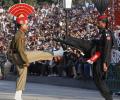
'Pakistan's capacity to carry a normal relationship with India doesn't exist.' 'The relationship with Pakistan is less important than several others.'

To persist with talks in the face of continuing terrorism that puts hundreds of Indian lives at stake is not only naive but morally repugnant and ethically unacceptable. It is time to see through this charade and abandon a path of high risk and no returns, says Vivek Gumaste.

Those who know Shiv Shankar Menon will vouch that he did lots of things, substantial in the immediate neighbourhood and widespread in South Asia, but without making things public. Twenty per cent of Menon's job was visible, while 80 per cemt of his job was not known to the public, says Sheela Bhatt/Rediff.com

The Security Council as it is today is unable to bring peace and security in the world and so there is reason for countries like India to become members of the Council, Ambassador Asoke Kumar Mukerji tells Sheela Bhatt/Rediff.com.

President Pranab Mukherjee on Monday addressed the first joint sitting of Parliament as mandatorily required under the Constitution after the general elections. The address is the political, economic and foreign policy road map of the Narendra Modi government and covers virtually all crucial areas.
